This report explains why the 60/40 portfolio has stopped working, how much bitcoin belongs in a modern portfolio, and what broader ownership means for bitcoin’s price.
Or continue reading…
Table of contents
Introduction
Most people’s life savings are invested for a world that no longer exists. Their financial wealth sits almost entirely in stocks and bonds, a mix that worked for 40 years because inflation was low, government debt was manageable, and bonds rose when stocks fell. All three conditions have now reversed.
Anyone still following this model is taking far more risk than they realize. They’re betting that stocks and bonds will hold up through exactly the conditions those assets are worst at surviving: high inflation and a steadily eroding dollar.
For most of history, people didn’t save in stocks and bonds. They saved in hard assets. Scarce things that no government can print, dilute, or default on have preserved wealth across centuries of currency regimes.
Bitcoin is the newest and most effective version of a hard asset. Its supply is fixed at 21 million coins, forever. This report argues that a bitcoin allocation of up to 10% of one’s portfolio is both a responsible and effective strategy for growing and protecting wealth. Many of Wall Street’s largest and most reputable firms are directionally in agreement with this thesis.
The first section of this report focuses on stocks and bonds. Specifically, it explains why these two asset classes have downsides that can only be addressed with a meaningful allocation to hard assets. Readers who are not interested in learning about the downsides of stocks and bonds are encouraged to skip this section.
The second section will provide a brief comparison between gold and bitcoin, before exploring what an appropriate bitcoin allocation may be.
The final section of the report covers notable bitcoin adoption trends in the financial services industry, as well as the price implications of broader bitcoin ownership.
The problem with most investment portfolios
For two generations, the default answer to “how should I invest?” has been some version of the same recipe: put 60% of your portfolio into stocks and 40% into bonds. This is widely known as the 60/40 portfolio.
The 60/40 portfolio has been a standard recommendation by advisors and treated as the responsible, grown-up choice. Between 1980 and 2020, typical returns ranged from 5% to 15% per year, with low volatility. Unfortunately, we no longer live in an era where the 60/40 portfolio works.
Bonds simply don’t provide the benefits they once did, and now carry significantly more risk. And while stocks have seen great performance over the past four decades, they significantly underperform during periods of high inflation.
Why bonds worked for forty years, and now don’t
A bond is essentially a loan. When you buy a bond, you’re lending money—usually to a government or a company—in exchange for regular interest payments and a promise to be repaid the original amount in the future. Bonds are traditionally considered “safe”; they have less upside than stocks, but provide a reliable stream of income and historically serve as a hedge for when stocks fall.
From 1980 to 2020, bonds were a great investment for reasons that no longer exist today:
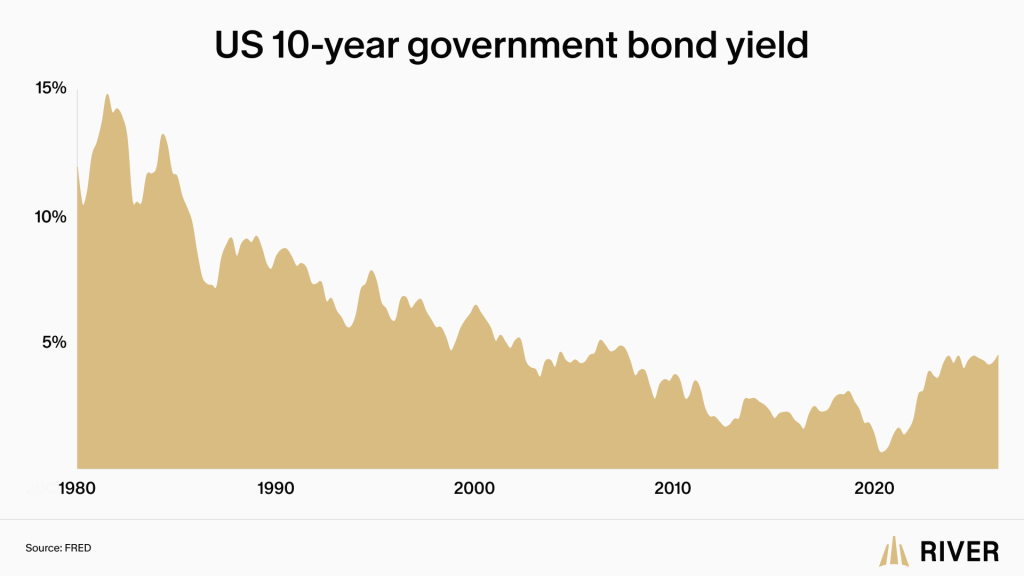
- Yields were high and falling for decades. In 1981, the 10-year US Treasury bond yielded nearly 16% per year. Over the next forty years, yields fell almost to zero. Because bond prices rise as yields fall, bondholders earned decades of capital gains on top of their interest. Today that has reversed: yields are low but trending back up, so bondholders now stand to lose money as yields rise.
- Inflation was low and well-behaved. From the mid-1980s until recently, inflation stayed low and predictable. That mattered enormously, because bonds pay back a fixed amount of dollars. When inflation is low, bonds hold their value. When inflation rises, bonds are a poor investment. Today, inflation is a large and growing problem for most Americans. The government’s large debt load suggests that high inflation may stick around for decades.
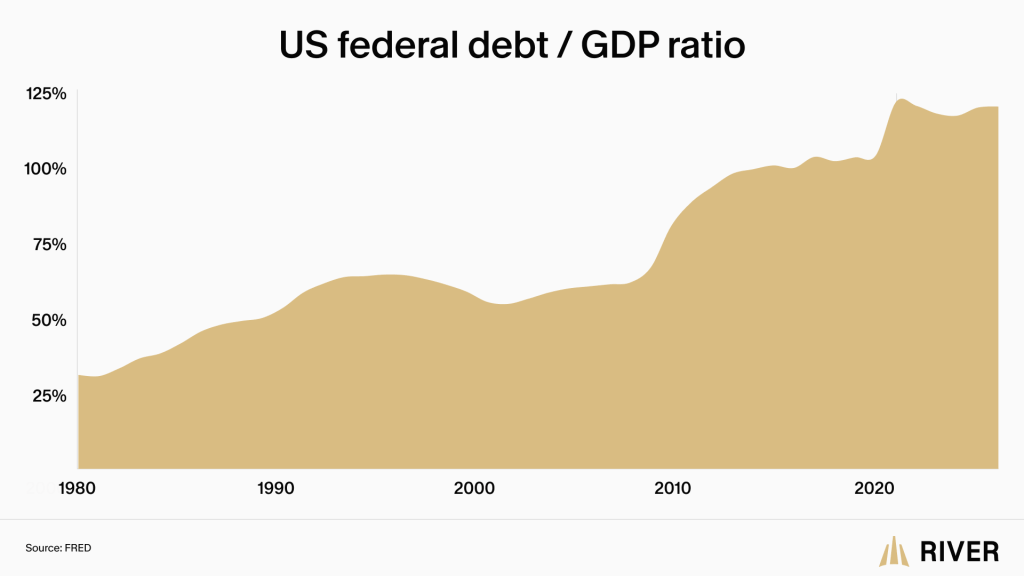
- Government debt was far lower. The US government’s fiscal backdrop in the 1980s was healthy. A government that doesn’t owe much can credibly promise to repay bondholders in money that holds its value. Today, the fiscal picture of the United States is unrecognizable from that of the 1980s. US national debt crossed $40 trillion in August 2026. Net interest costs have nearly tripled in five years and are on track to consume close to 14% of all federal spending. The US government debt to GDP ratio has tripled in 40 years. A government in that position has a powerful incentive to let inflation quietly erode what it owes, and bondholders are the ones who pay that bill.
- Bonds served as a counterbalance to stocks. For most of the past 40 years, stocks and bonds were negatively correlated: When the price of stocks fell, bond prices typically rose. That negative correlation is what justifies holding 40% of a portfolio in bonds, because bonds served as a reliable counterbalance to one’s portfolio. Today, bonds are now positively correlated with stocks, meaning that rather than being a counterbalance, they can actually increase the risk of portfolios.
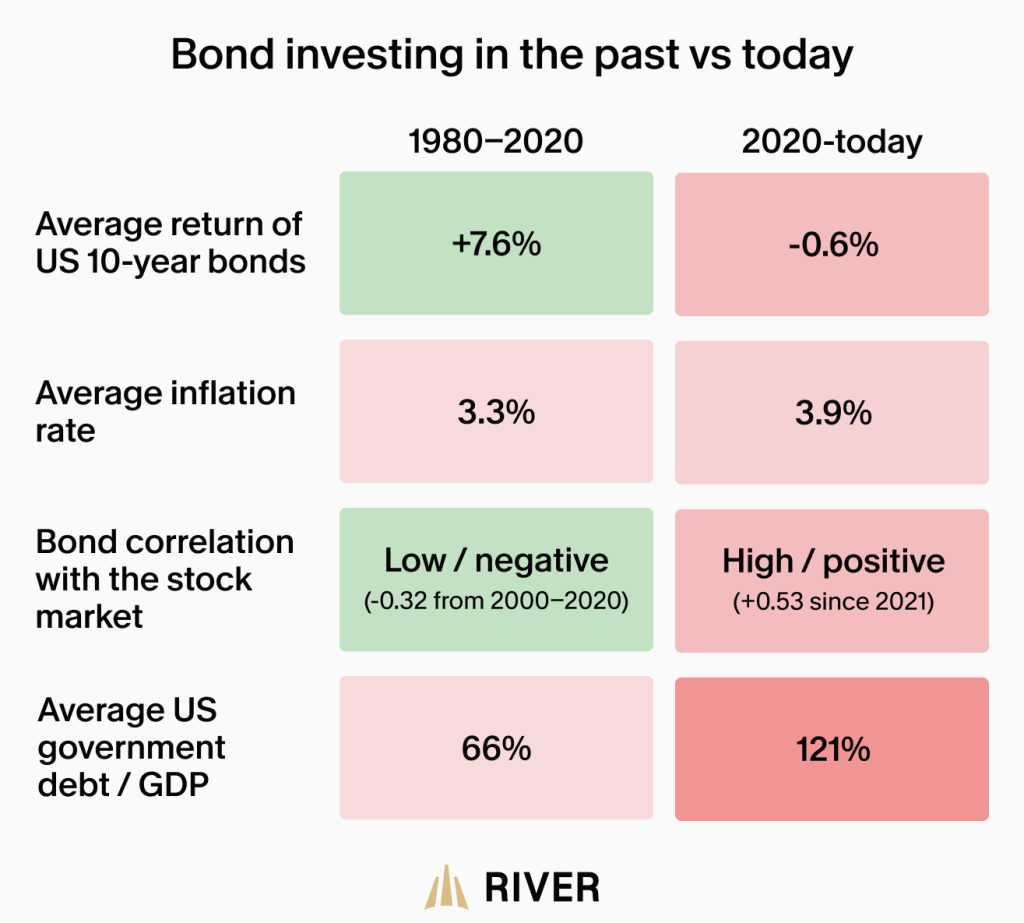
Taking these factors together, the 60/40 portfolio no longer makes sense. A 40% allocation to bonds today means lending 40% of your savings to the most indebted government in history, to be repaid in a currency that same government has every reason to debase.
This is not to say that bonds are worthless. They still have a role for near-term, known liabilities. But the idea that people should put 40% of their savings into bonds rests on assumptions that have stopped being true.
What today’s portfolios are missing: hard assets
Today, the 60/40 portfolio is lacking two qualities:
- Protection against periods of high inflation and monetary debasement
- A counterbalance that can outperform when stocks and bonds fall
What is missing is an allocation to assets that cannot be debased: scarce, hard assets that no government can print, dilute, or default on.
Gold is the historical version of this idea. It has preserved purchasing power across centuries and currency regimes precisely because its supply can’t be expanded at will.
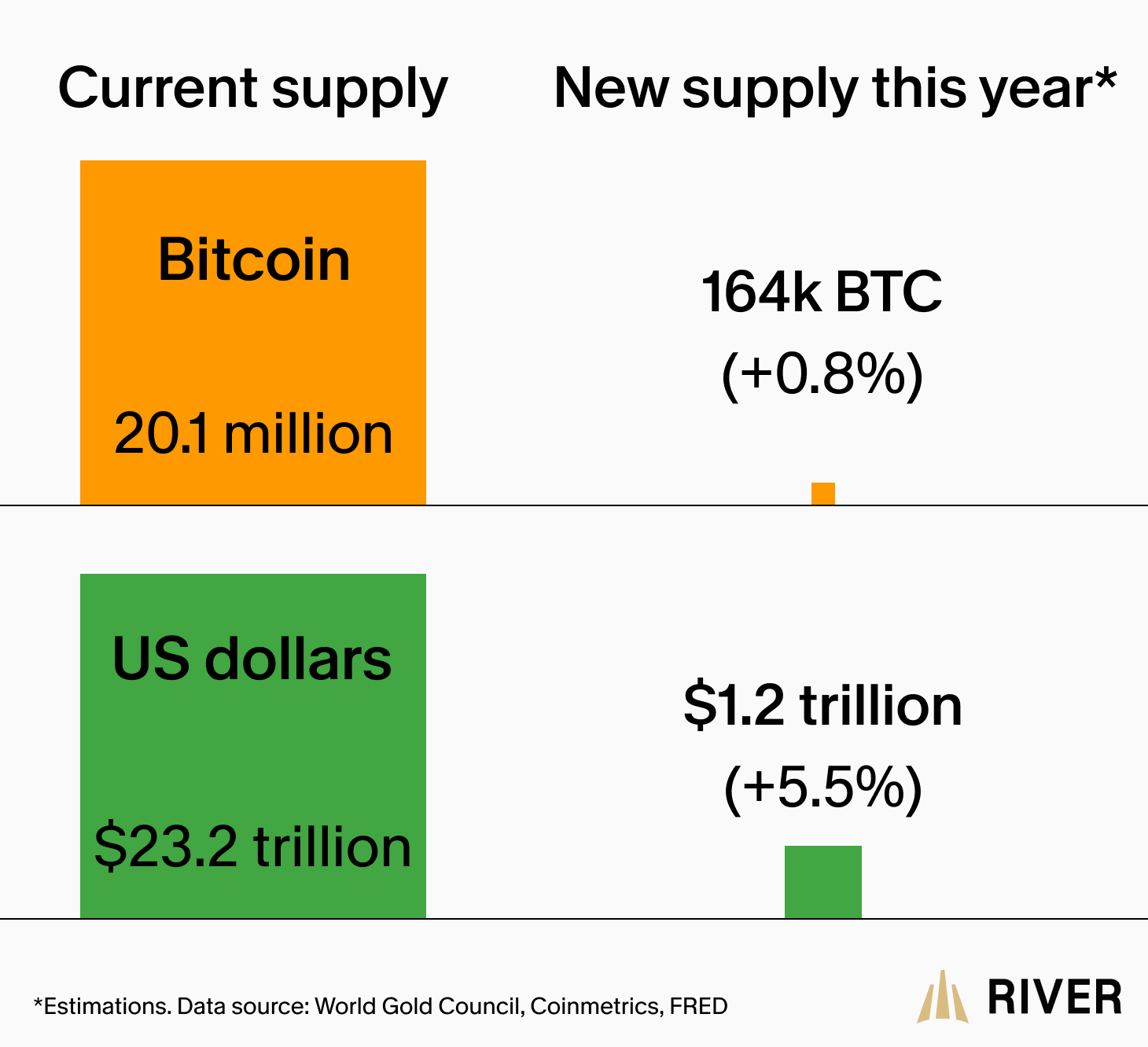
Bitcoin is the digitally native, and in key respects a more pure, version of the same idea. Its supply is mathematically fixed at 21 million coins. Like gold, it is a bearer asset with no counterparty risk. Unlike gold, it is perfectly portable, divisible, and verifiable.
Aren’t stocks an inflation hedge?
A common misconception is that you don’t need hard assets because stocks are a good inflation hedge. Stocks fail as an inflation hedge exactly when it matters most: when inflation runs high for prolonged periods of time.
The most recent example of this was the 1970s, when inflation averaged more than 7% per year. During this period, the stock market fell by 45.3% over 13 years, while gold surged by 514%, after adjusting for inflation.
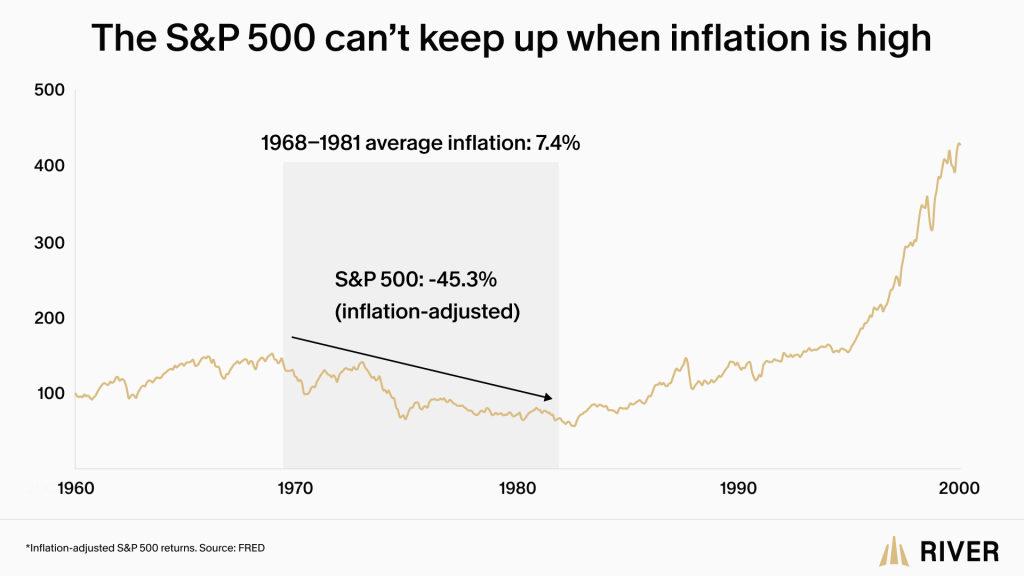
Applying the same time frame today, most people cannot imagine seeing their life savings cut in half by 2039, but history has shown that it is possible.
The most recent example of high inflation was 2022, where inflation averaged 8%, stocks fell by 19%, and bonds fell by a similar amount due to rising interest rates. An investor with a 60/40 portfolio lost over a quarter of their purchasing power within 12 months.
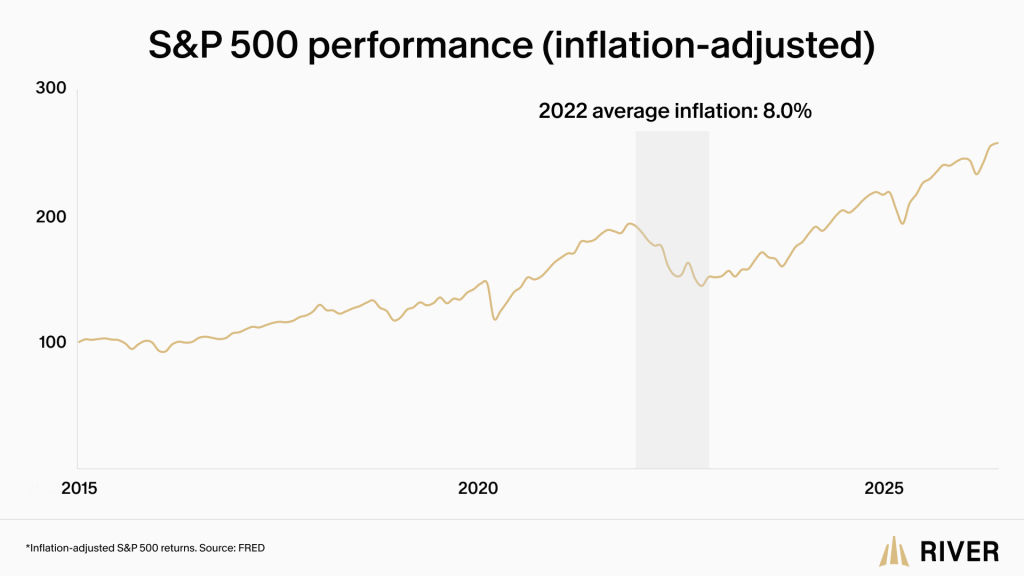
Stocks are small pieces of ownership in a company, allowing you to participate in their growth. Over a lifetime, they can be a powerful way to build wealth. But they are not insurance, and are still susceptible to the erosion of the dollar. When the money itself is being debased, the assets that protect you are the ones whose supply stays fixed.
The rest of this report explores how much of that hard-asset exposure should be bitcoin, and why, for most investors, the right starting point is meaningfully above zero.
Comparing gold and bitcoin
Gold and bitcoin are both scarce forms of money outside any government’s control. They’re best understood as complements, not rivals.
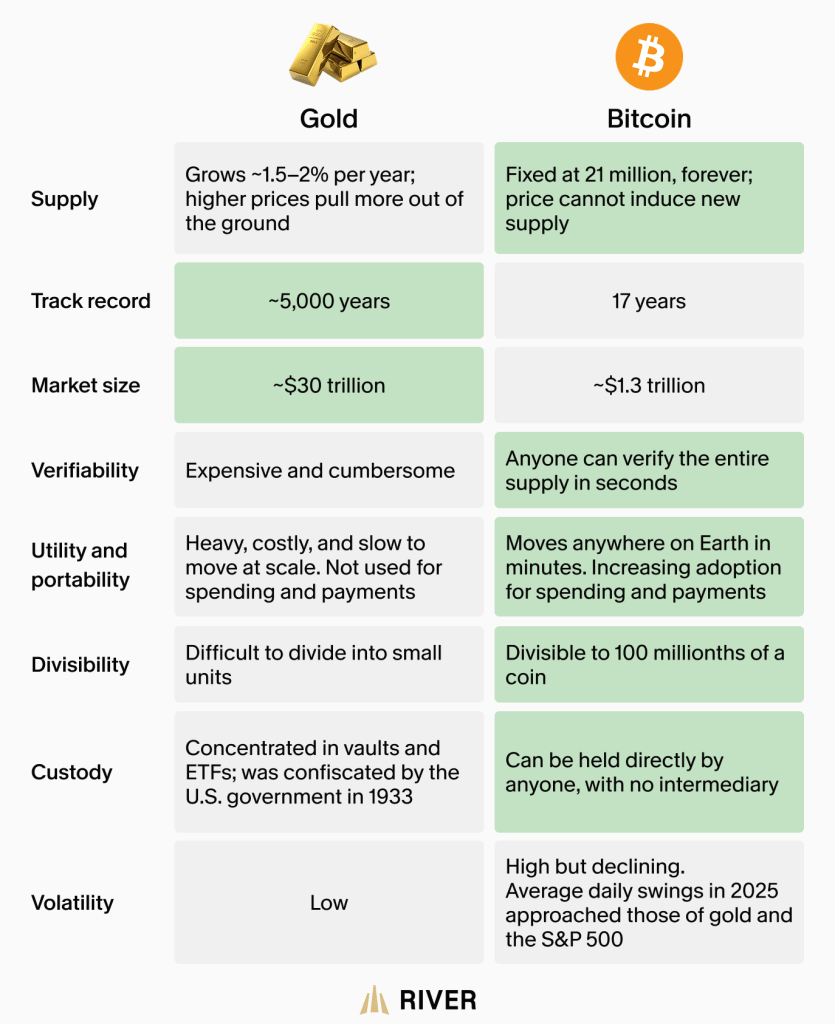
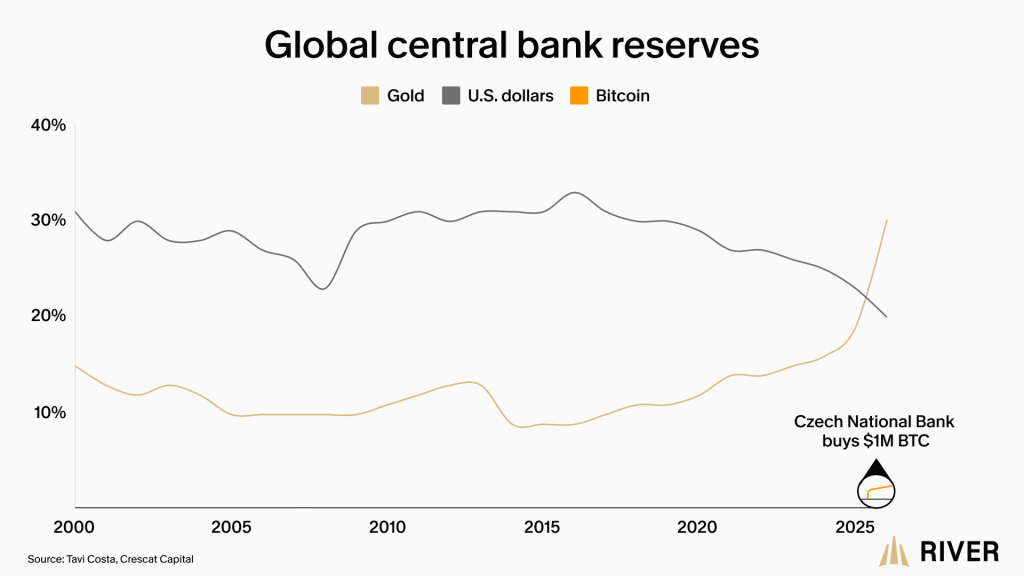
The case for gold is that it’s a primary global reserve asset that has been around for thousands of years. In 2025, gold surpassed US dollars as the most widely-held central bank reserve asset.
The case for bitcoin is that it has superior qualities as a store of value for the modern world, yet is less than 5% the value of all gold. If the world continues to shift more towards hard assets for savings, the smaller, harder, more portable asset has far more upside potential.
If you are new to bitcoin, we recommend starting with this 10 minute crash course on the basics of bitcoin investing.
How much bitcoin should you own?
We’ve established that hard assets belong in a modern portfolio, and that bitcoin is the hard asset with the most room to grow. The question is no longer whether to own any, but how much.
A bitcoin allocation does three things for an investment portfolio:
- It diversifies. Over the medium-to-long term, bitcoin shows little correlation with stocks, bonds, and most other asset classes. Its price is not particularly driven by economic cycles, interest rates, and other factors that have large impacts on stocks and bonds. This is a valuable quality for investors, as a bitcoin allocation can help dampen the impact of large price declines of other asset classes.
- It hedges inflation. Bitcoin is insurance against the one scenario where stocks and bonds fail together: sustained inflation and monetary debasement.
- It adds upside. Most insurance costs you something to hold. Bitcoin has done the opposite so far as one of the best-performing assets of the past decade.
Bitcoin’s main downside is its volatility. Its price swings can be more dramatic than stocks, bonds, and gold. The challenge then becomes determining the appropriate allocation within a portfolio. Too small of an allocation, and you stand to miss out on large long-term returns. Too large of an allocation, and you may expose your portfolio to price swings that are too large to handle.
The bare minimum bitcoin allocation
As of August 2026, bitcoin represents 0.5% of the world’s financial assets.
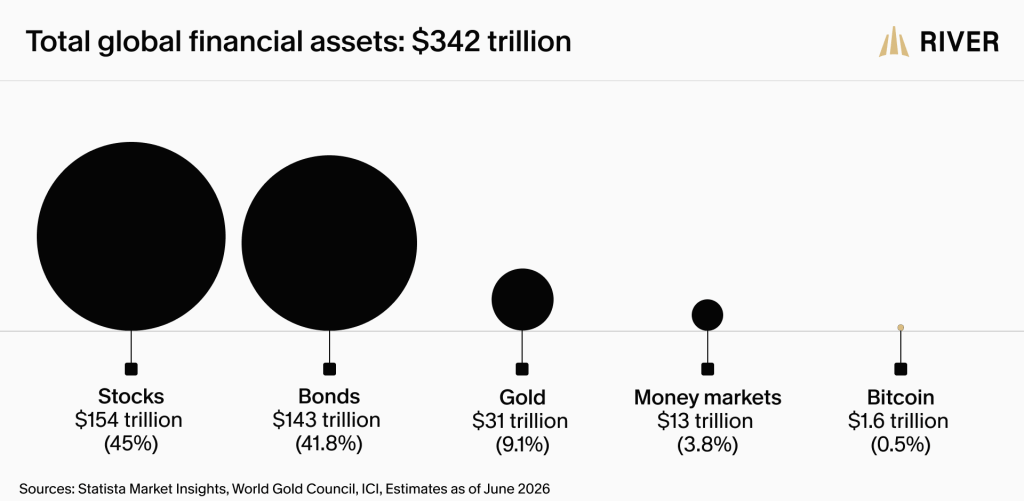
A truly neutral portfolio would simply hold the world’s financial assets in proportion to their size. That portfolio includes 0.5% bitcoin. Hold less, and you are making a bet that bitcoin will lose value or relevance.
We see 0.5% as a floor, not a target. Hedging your portfolio against inflation without overexposing it to risk merits a much larger bitcoin position.
The case for a 10% bitcoin allocation
We believe an appropriate bitcoin allocation for most long-term investors is at least 10%.
We modeled a standard 60/40 portfolio and then replaced part of the bond allocation with bitcoin, in increments from 1% to 30%. Here is the past decade:
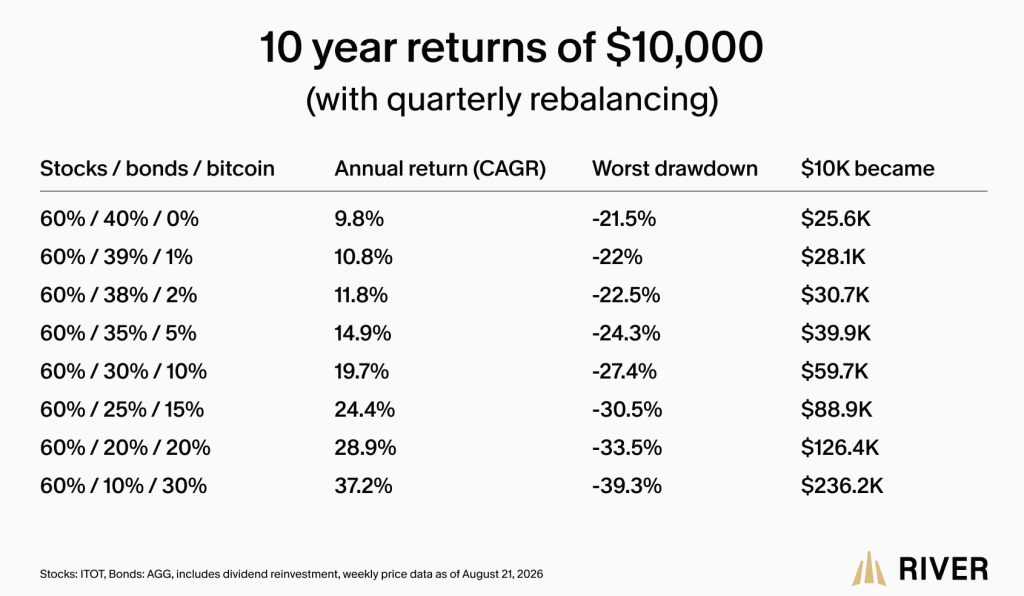
Over the past decade, maintaining a 10% allocation to bitcoin more than doubled the ending value of the portfolio ($60,595 versus $25,364) while the worst peak-to-trough loss grew by just six percentage points.

Accepting a small amount of additional volatility has historically unlocked a disproportionate amount of return. That is the bitcoin allocation argument in its simplest form. The same is true for three and five-year time periods.
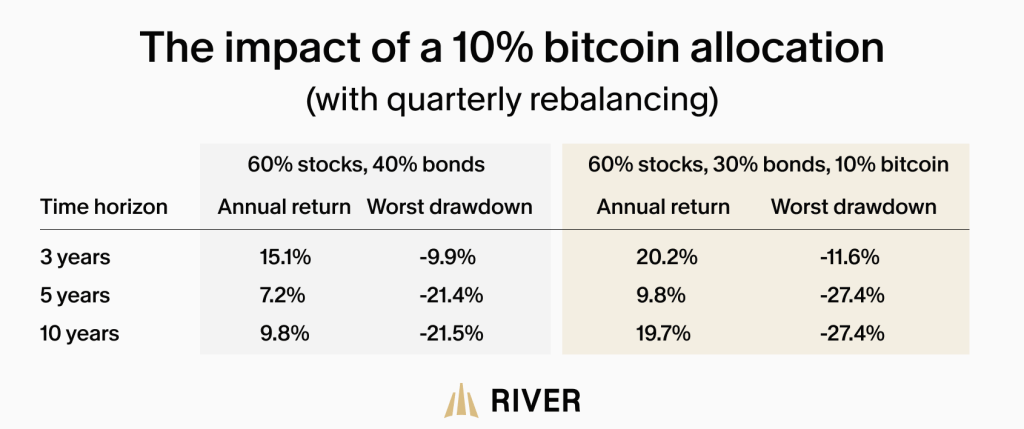
Past performance never guarantees the future. But the claim that bitcoin’s volatility makes it too dangerous to invest in is simply not what the numbers show. At a 10% weight, bitcoin’s volatility has been a manageable cost attached to a substantial benefit.
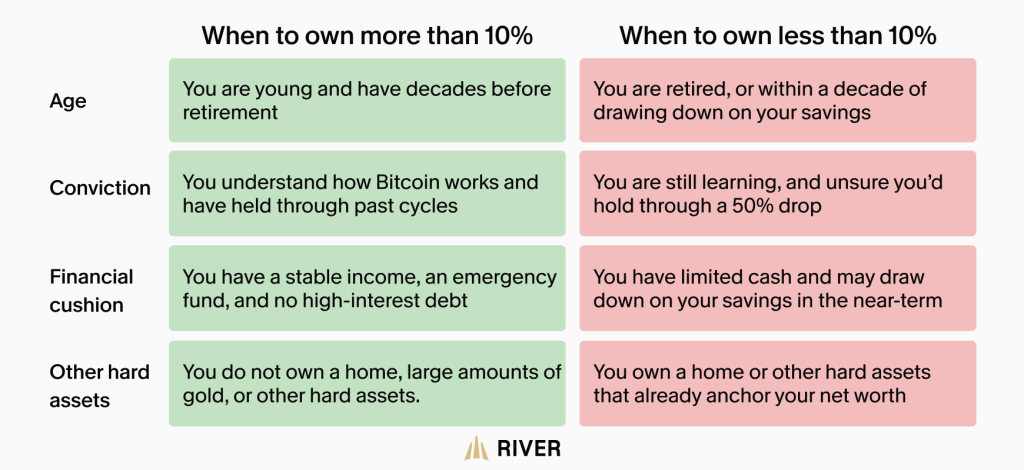
When to consider a different bitcoin allocation:
10% is our base case for a typical long-term investor, but the right number may be different depending on your situation. There are four main factors to consider: your time horizon, your conviction, your financial cushion, and whether you already own hard assets, as summarized below:
Current market context in September 2026.
We are publishing this report with bitcoin around $80,000, roughly 37% below its October 2025 high. Every number in our analysis includes this current drawdown. The results are not cherry-picked during times when bitcoin outperformed; they include the worst-performing periods bitcoin has ever experienced.
Our analysis also assumes investors rebalance the weights of their allocations each quarter, which removes the timing question entirely.
Owning bitcoin is becoming normal. What are the implications?
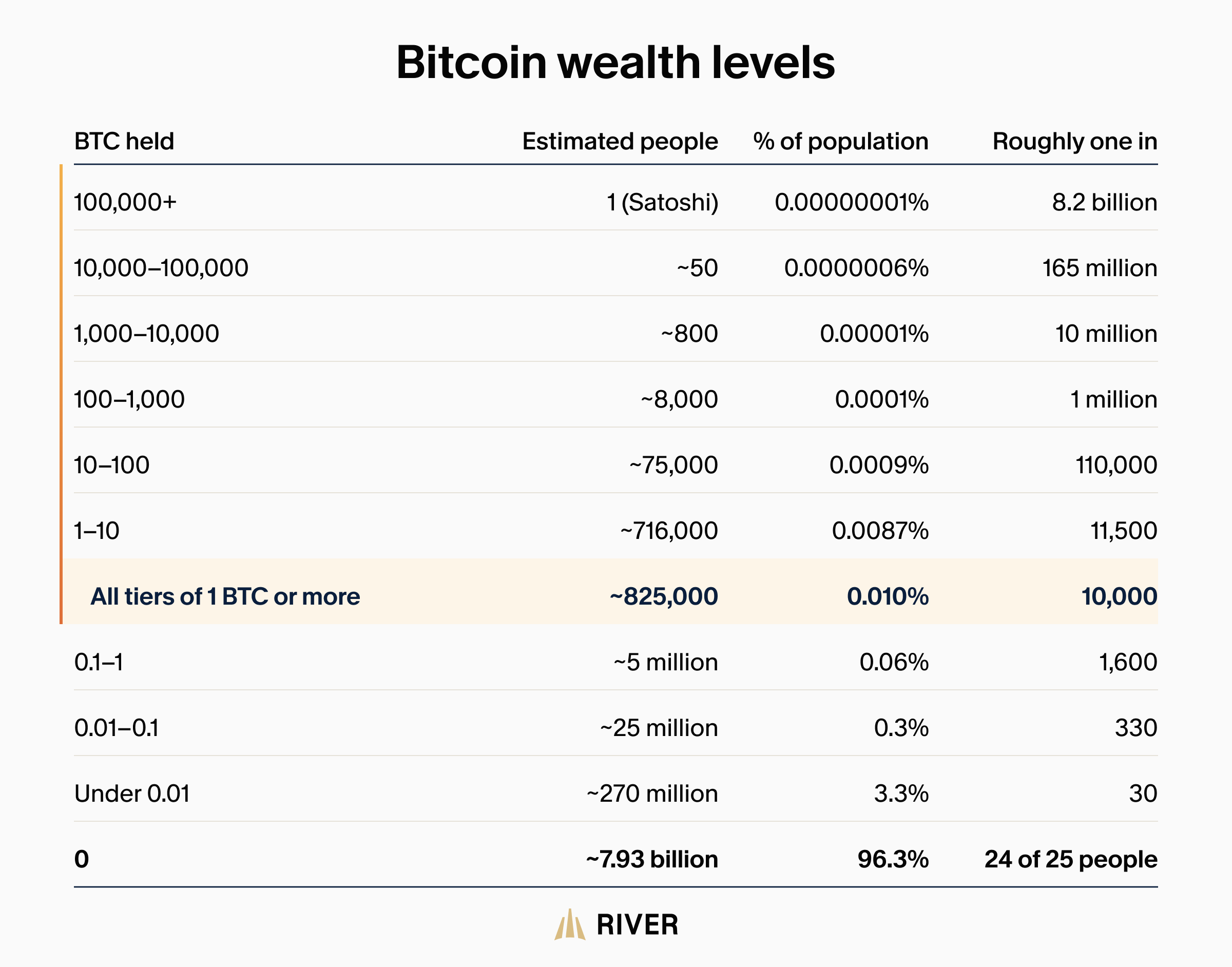
Roughly 4% of people worldwide own any bitcoin. Those who do tend to hold small amounts, and few treat it as a core part of their portfolio.
Institutional investors, who manage 50% of global financial wealth, began making meaningful allocations to bitcoin in 2024 after the launch of Bitcoin ETFs. Today, investment advisors as a whole have just a 0.008% allocation to bitcoin.

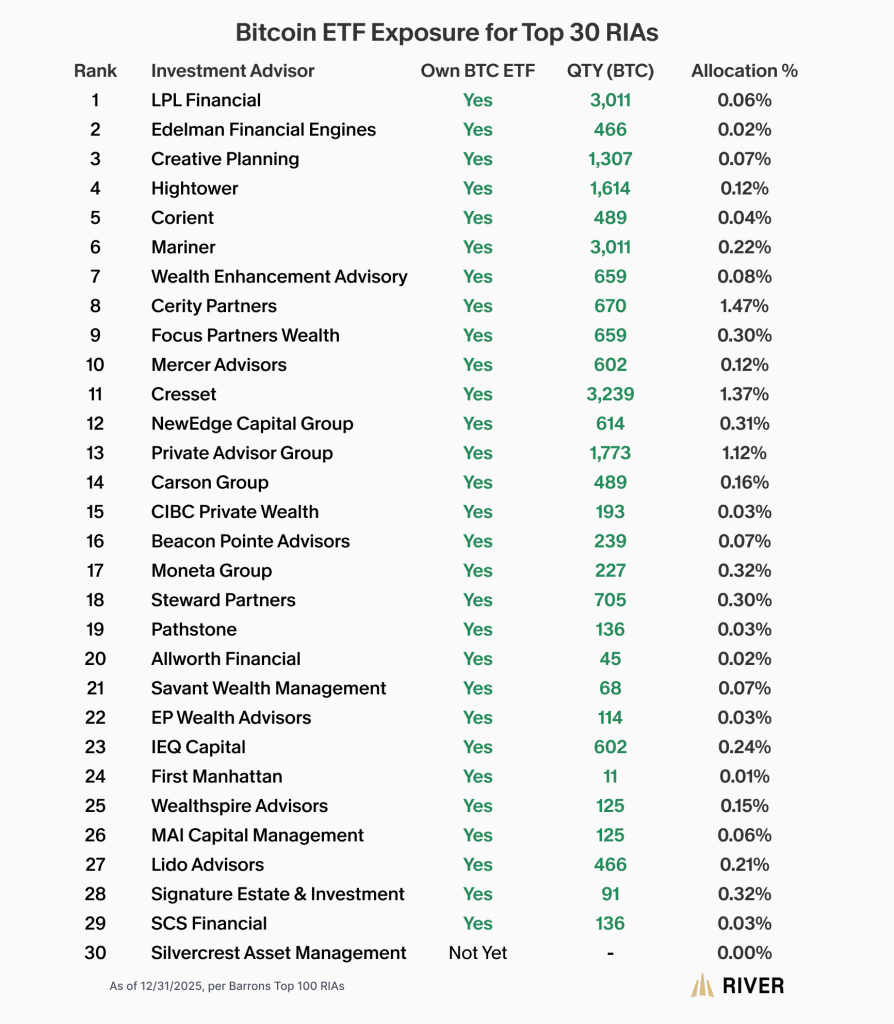
But this is beginning to change. Bitcoin is now widely considered to be a valuable addition to most investment portfolios. In the United States, 29 of the top 30 Registered Investment Advisors (RIAs) now own bitcoin. The median allocation remains small at 0.10%, but is steadily growing each year.
A large majority of the top banks are now building bitcoin products for their clients.

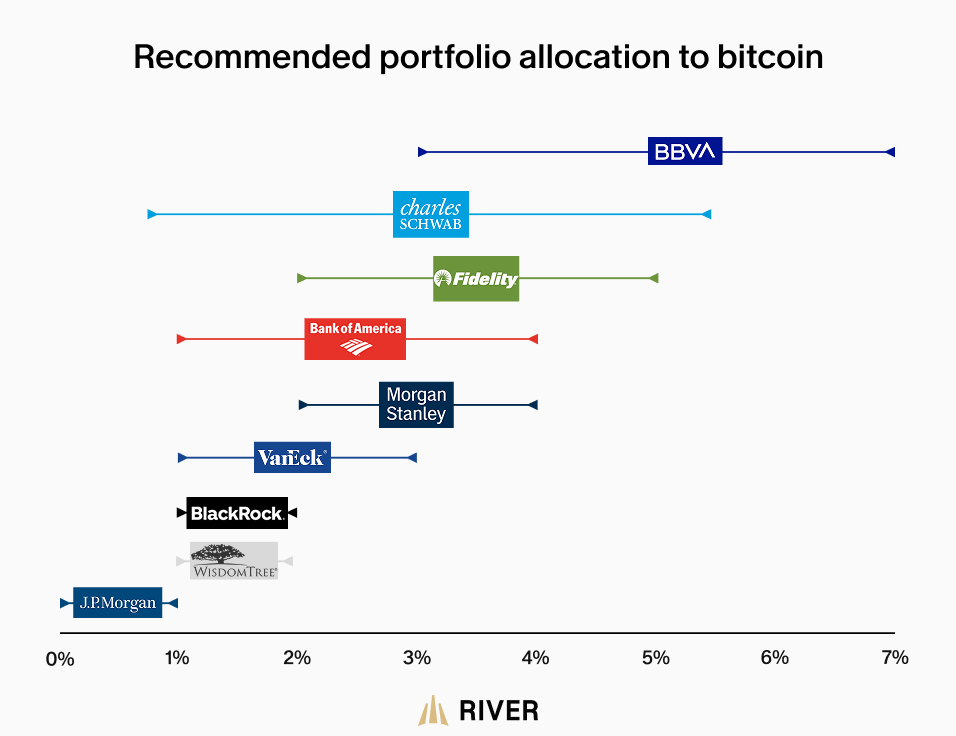
Wall Street now stands to benefit from bitcoin adoption. They no longer have a reason to steer clients away from it. The most well-established financial institutions recently began recommending meaningful bitcoin allocations to their clients.
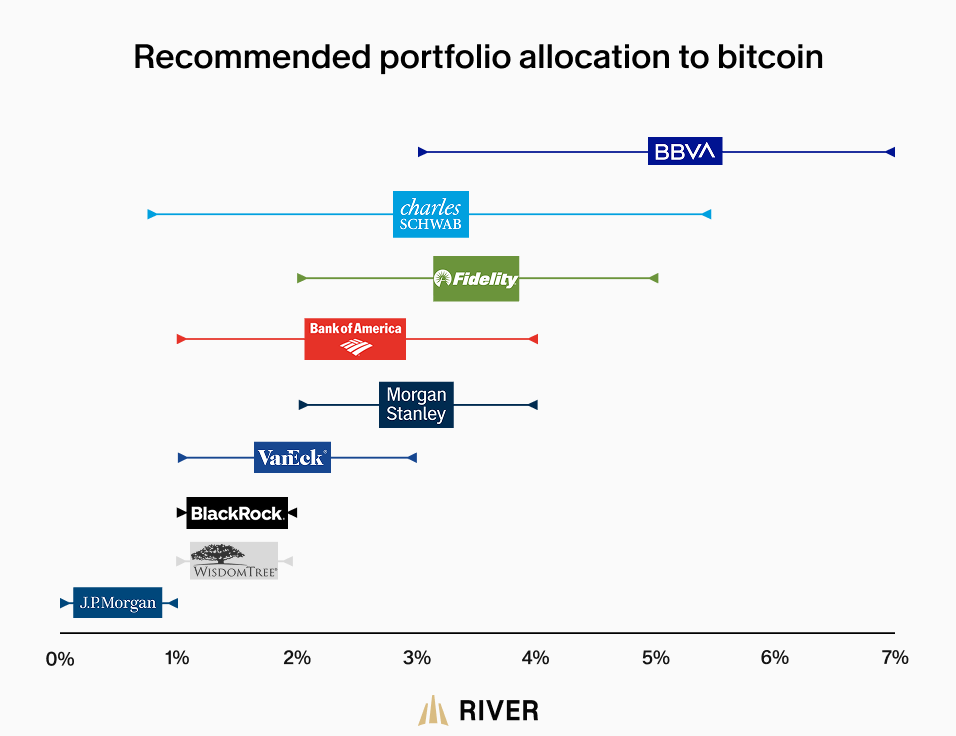
The world’s largest financial institutions are telling people to buy an asset that almost no one owns, with a supply that cannot expand to meet them. Increased demand for a fixed-supply asset can only be resolved in one way: through price.
Modeling the effect of capital inflows on bitcoin’s price
Broader ownership of bitcoin has price implications. Below, we make a three to five year price forecast by estimating two numbers:
- Capital inflows into bitcoin
- How much each dollar of inflow moves bitcoin’s market value
Capital inflows depend on two things: how many existing and additional portfolios add bitcoin, and how large those allocations are.
Financial advisors, who manage roughly half of all wealth in America, are adopting bitcoin quickly. According to a survey by Bitwise, the share of advisors allocating to crypto (of which bitcoin is the largest component) rose from 22% in 2024 to 32% in 2025. 56% plan to add it or are considering it. It must be noted that the average bitcoin allocation among these advisors remains very small at less than 0.1%.
If adoption grows at even half its 2025 pace, 45–55% of advisors would be allocating within three to five years. We use a more conservative range of 20–40% of portfolios, because adoption is less certain among investors who don’t use advisors, and among investors outside the United States.
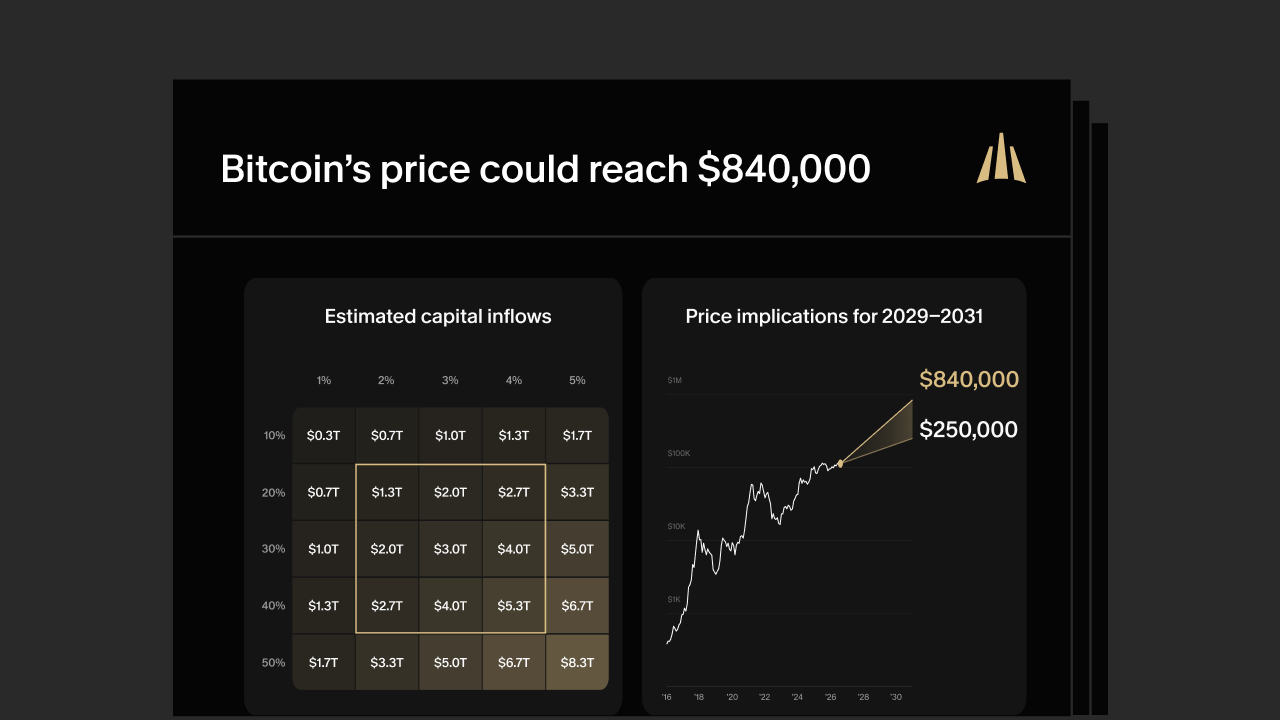
We estimate these portfolios will, over time, make average allocations of 2–4% to bitcoin, in line with guidance from Wall Street’s largest firms. Against a global financial asset base of roughly $333 trillion, that implies $1.3–5.3 trillion of net inflows over the next three to five years.

This estimate lines up with the growth in capital inflows across bitcoin’s previous bull markets, as shown in the chart below.

The implications for bitcoin’s price
Financial markets are not perfectly elastic: when new money enters an asset and existing holders don’t sell, prices must rise by more than the inflow itself. Economists Xavier Gabaix and Ralph Koijen found that every $1 invested in the US stock market raises its total value by roughly $5.
Bitcoin shows the same pattern. $1 of net inflows produced $4.50 of market value growth in 2015–2017, $3.30 in 2018–2021, and $3.10 in 2022-2025. Over the next three to five years, we assume bitcoin’s market value will grow by $3 for every $1 of net inflows.
At a 3X multiple, inflows of $1.3-5.3 trillion imply a bitcoin market value of $5.5–17.5 trillion. This equates to roughly $250,000 to $840,000 per coin, with the low end requiring nothing more than the current pace of adoption continuing.

This forecast relies on simple assumptions that could prove wrong for multiple reasons. Capital inflows to bitcoin (and bitcoin’s corresponding price) could fall short of, or exceed, the ranges indicated in this analysis.
Furthermore, financial markets are highly complex and difficult to predict. The financial landscape is becoming increasingly uncertain as a result of technological progress, geopolitical conflict, and fiscal fragility, among other factors.
But one thing remains the same: the Bitcoin protocol continues to operate as originally designed 18 years ago. Bitcoin continues to be the most transparent and scarce form of money ever created, and its adoption continues to spread at a steady pace.
River does not provide investment, financial, tax, or legal advice. The information provided is general and illustrative in nature, is not a recommendation to buy or sell any asset, and should not be relied upon for tax or investment decisions. Bitcoin and other assets are volatile and may lose value. Past performance is no guarantee of future results. Hypothetical portfolio results do not represent actual trading and do not account for taxes or fees. Consult an appropriate professional regarding your individual circumstances.